BML/OS
BML/OS is the system of actionfor delivering the success of a deal.
AI-powered software we built and own from the experience of 50+ transactions and over £20bn of enterprise value. Every tech & ops diligence finding, transition service agreement (TSA), dependency, integration/transition task and value lever lives in it as a live item with an owner and a date, from pre-deal through to exit. Sponsor, management, our operators and the other advisers all work in the same record.
It replaces the diligence PDF, the TSA spreadsheet, the integration tracker, the monthly deck and the shared drive.
BML/OS comes with the team on an engagement. It is not sold as standalone software.
Without it, with it
Six things every transaction has to keep hold of — and how AI changes them in BML/OS.
Tech & operations diligence
Findings arrive as a PDF. Hidden risks — cross-system dependencies, separation issues, value-at-risk — get read once, then re-discovered a year later when the problem surfaces.
AI-assisted diligence surfaces hidden risks and enters them in the record already scored, with an owner and a date, so they carry straight into delivery instead of surfacing late.
TSA and transition
A static TSA exit date in a spreadsheet, tracked by email, with milestones and risks scattered across teams.
A live TSA register with owners, milestones, risks and exit criteria, visible to management and the sponsor in the same record.
Dependencies and integration
System diagrams in Visio, dependencies in spreadsheets, no live view of how value levers and workstreams connect.
BML/OS automatically creates an enterprise architecture and integration map across the organisation, with key dependencies, powered by AI in real-time.
Value creation
A number in the model, argued about at exit, with no line back to who delivered what.
AI tracks each lever from baseline to forecast and realised, attributable to a named owner and the work that produced it.
Status
Whatever the last confident person in the room said it was.
A system state — AI wires RAG and process health to the workstreams, dependencies, risks and decisions underneath.
History
Lives in inboxes and heads. One person leaves and the reasoning goes with them.
Dated, attributable decisions and one document repository. The record survives the people.
One critical item, end to end
What “system of action” actually means on a deal.
Follow a single critical item from the day it is found to the day a buyer asks about it. The scenario below is illustrative; the mechanism is not.
Found in tech & ops diligence
Enhanced diligence identifies a critical shared dependency — say a warehouse management system still tied to the seller (illustrative). It is logged as an item in the record, not a bullet in a report.
Scored and owned
Separation risk, integration effort and TSA impact are scored. A named owner is assigned on the technology side, with a TSA exit date. The sponsor can see it from day one.
Carried into the transition plan
The same item becomes a workstream in the transition plan, with its dependencies, data-migration tasks and risks attached. Nothing is retyped, so nothing is lost between diligence and delivery.
Tracked through TSA exit
Integration testing, data migration and TSA exit move as milestones land. When a date slips, the slip has a reason, an owner and a revised date against it.
Tied to the value it creates
The dependency is linked to the cost, working capital or risk-reduction lever it enables. Realised value is attributable to the same item that was identified in diligence.
Still there at exit
Two years later a buyer asks how the separation was decided. The decision, its date, its author and the evidence behind it are in the record.
Nothing in that sequence is retyped, re-assembled or remembered. That is the whole product. The screens below show the same journey: where the item lives, how the stage gates track it, and what the sponsor reads.
Who's it for
Five kinds of buyer, five different problems. Here is what the software does about each one.
Inside the record
Not slideware. These are screens from the live product our own people log into every day — and the same product a client logs into alongside us.
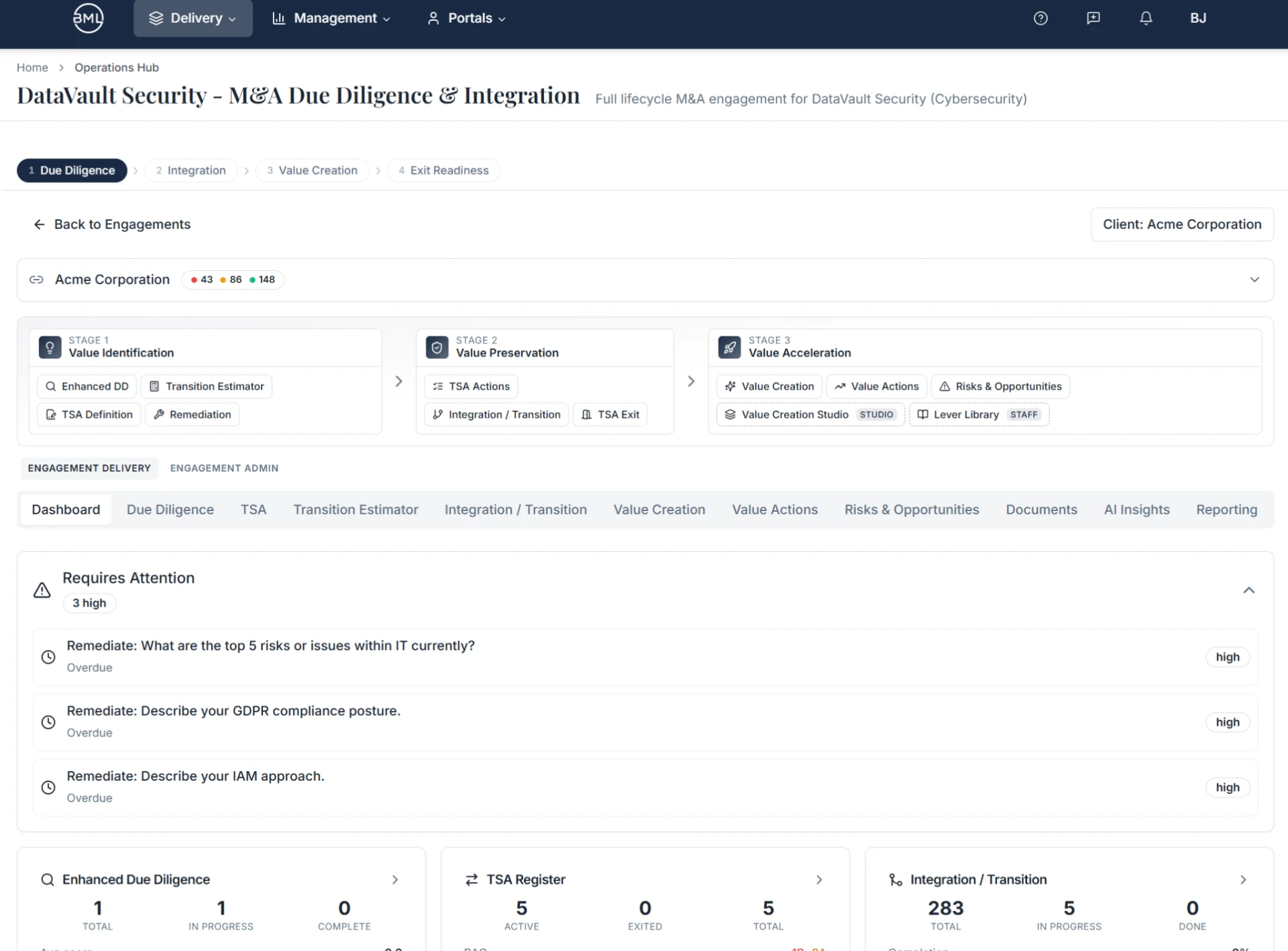
A live engagement: the shared dependency from the example above sits here, next to the TSA register, the risks against it and the value lever it enables.
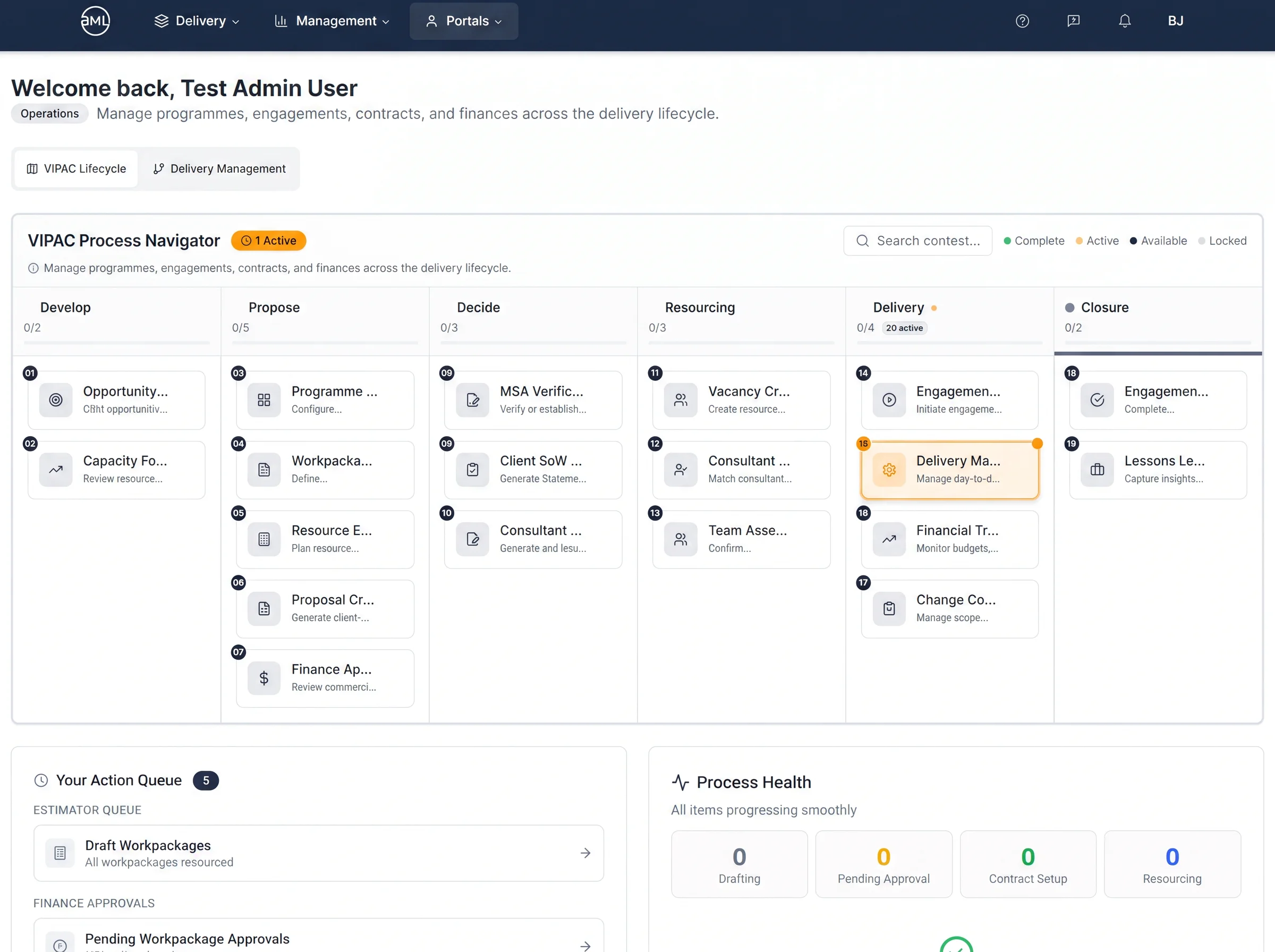
Nineteen steps across six stages, from opportunity through to lessons learned, with the action queue, TSA milestones and process health beside them rather than in a status report.
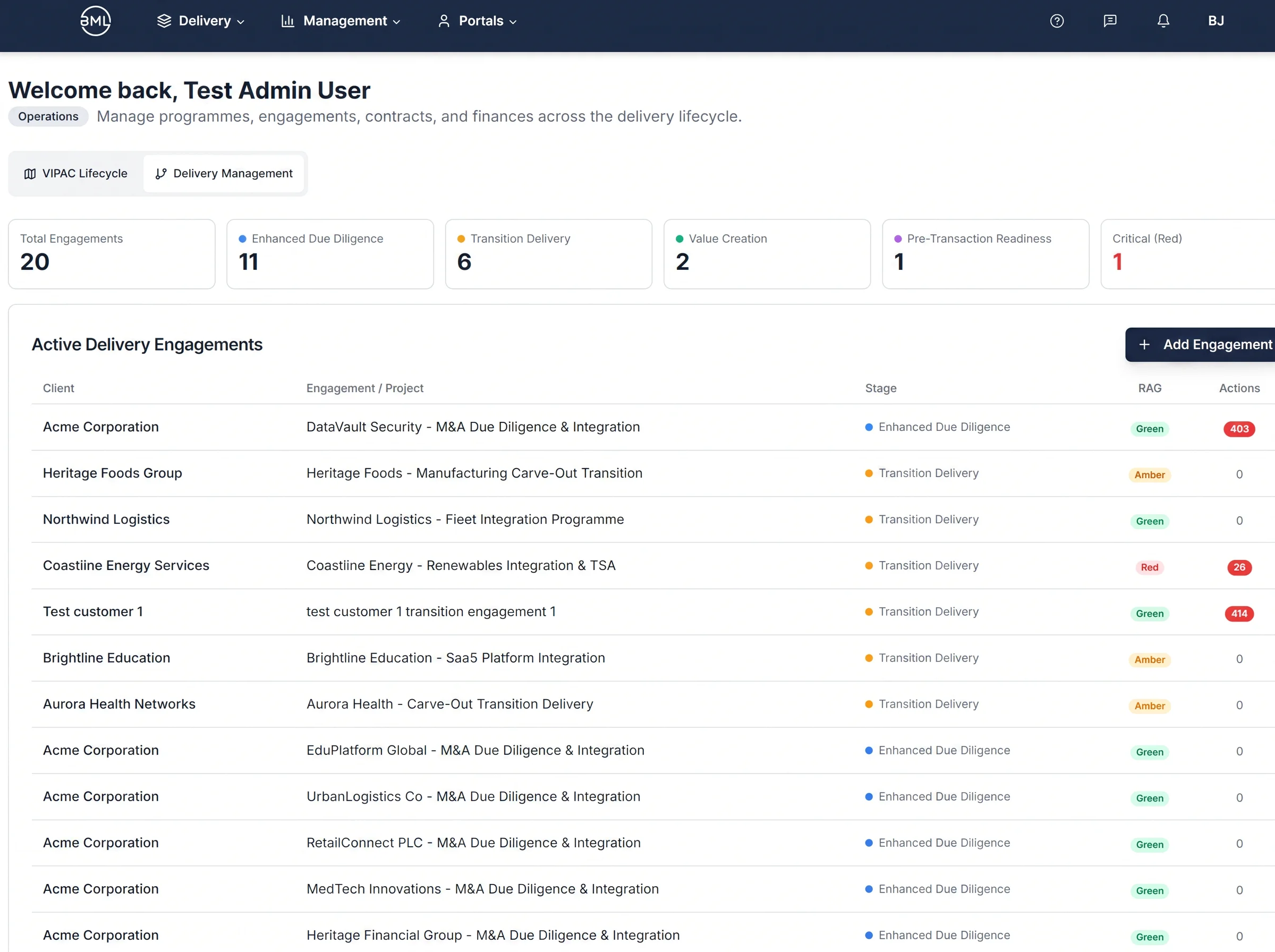
Every live engagement in one place, with VIPaC stage, RAG status, TSA exit and open actions against each. This is the view that replaces the board-pack wait.
Through the lifecycle
Pre-readiness
BML/OS establishes the baseline: workstreams, owners, risks and the value levers that will be tested later.
Diligence
Findings, quantification and value levers are captured in BML/OS so diligence carries straight into delivery.
Transition
One plan, one risk register, one decision log across both sides of the transaction.
Value creation
Value levers are tracked against baseline, owner and realised effect, not against slideware.
Exit
The engagement record becomes the evidence pack: decisions, levers, delivery and realised outcomes.
What we own, what we partner
One product we own, partners we chose deliberately, and the work it all runs.
BML/OS
The operating system every engagement runs on. Playbooks, value levers, workstream structures and reporting cadence, productised — and configured to each client. No two configurations are identical.
ExpertIQ
Applied AI for high-SKU manufacturers, distributors and B2B/B2C retailers. Product, pricing and assortment complexity turned into decisions at machine speed.
Quilr
Adaptive guardrails and AI security posture management for shadow AI, prompts and autonomous agents. Trusted by UiPath, Spotnana and Hitachi.
Claude
Twenty-two associates in Anthropic training and certification, and on the path to Anthropic partnership.
Two of the three products are partners, which means we can commit to them in the room and swap them between engagements without owning the roadmap.
Value identification
We find where the money is — in the diligence, the hundred days, or the value-creation plan. Our operators ask the right questions of the right people until it is a plan the CFO can sign.
Workflow redesign
We redraw the commercial, organisational and decision workflows before any product goes in, not after. That is where most AI programmes quietly fail. We don't skip it.
Change and adoption
Training, coaching, comms, incentive design, org restructures. Standing up the technology is the easy part. Making it stick is the work.
Governance and safety
Guardrails, review cadence and the operating model that keeps AI usage safe as it scales. Not a click-once install, an ongoing operating discipline.
Outcome measurement
We wire the KPIs back to the investment thesis and hold ourselves to them. The value only counts if it turns up in the reporting.
Accelerated by AI
AI powers the record, not the accountability.
AI powers the whole record: it compresses analysis, synthesis and reporting, and automatically creates an enterprise architecture and integration map with key dependencies in real-time. Senior operators spend their time on judgement and delivery. Every output has a named owner. Twenty-two of our associates are in Claude training and certification, and we are on the path to Anthropic partnership.